Korean Clothing Store Phrases for Beginners: Size, Fitting Room, Price, and Payment
Learn simple Korean clothing store phrases for size, color, fitting rooms, price, payment, exchanges, and polite shopping help.
Learn simple Korean clothing store phrases for size, color, fitting rooms, price, payment, exchanges, and polite shopping help.
Learn simple Korean hotel check-in phrases for reservations, passport confirmation, room requests, breakfast, Wi-Fi, checkout, and help.
Learn practical Korean grocery store phrases for finding items, asking prices, paying, receipts, bags, and simple help situations in Korea.
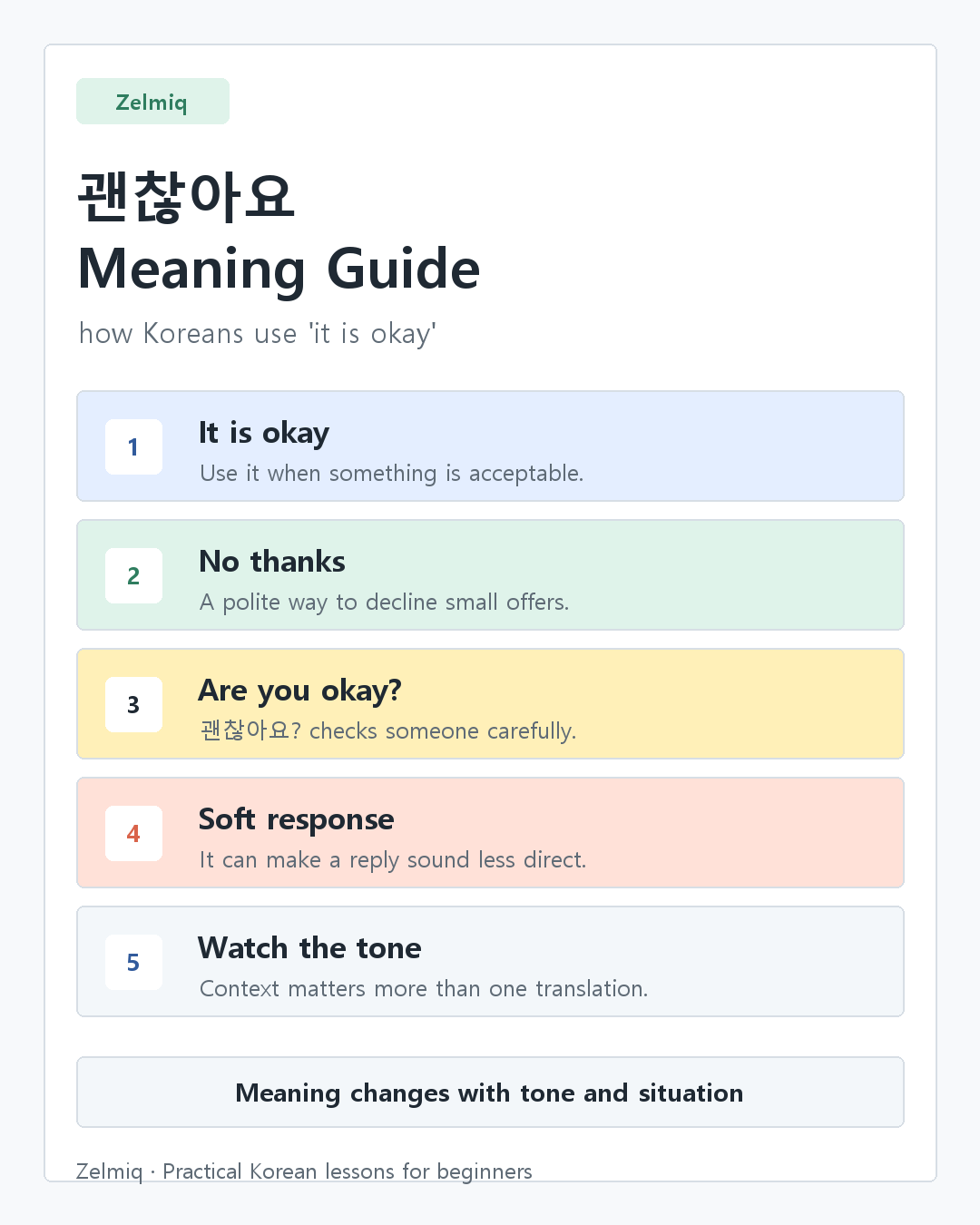
The Korean phrase 괜찮아요 is one of the most useful expressions beginners can learn. It often means “It’s okay,” “I’m okay,” “That’s fine,” or even “No thanks,” depending on the situation. This is why 괜찮아요 meaning can feel confusing at first. English uses different phrases for different situations, but Korean can use 괜찮아요 in many … 더 읽기
If you watch K-dramas, listen to K-pop, or talk to Korean friends, you have probably heard words like oppa (오빠), unni/eonni (언니), hyung (형), and noona/nuna (누나). The short answer is this: these are Korean words used to address someone who is older than you, but the exact word changes depending on your gender and … 더 읽기
If you are just starting Korean, learning how to introduce yourself is one of the best things you can do early on. It is practical, confidence-building, and surprisingly flexible. The good news is that a simple Korean self-introduction does not need advanced grammar. A few polite phrases can already help you make a warm first … 더 읽기
If you want to say sorry in Korean, the three most useful expressions are 죄송합니다, 미안해요, and 미안. They all connect to apology, but they are not interchangeable. The fastest way to understand them is this: 죄송합니다 is formal and respectful, 미안해요 is polite and common, and 미안 is casual. That simple pattern will already … 더 읽기
If you only learn one Korean phrase for gratitude, many textbooks will teach you 감사합니다. And yes, it is correct. But in real life, Koreans also say 고마워요 and 고마워 all the time. So what is the difference? In one sentence: 감사합니다 is formal and respectful, 고마워요 is warm and polite, and 고마워 is casual … 더 읽기
If you have ever looked at a Korean message and thought, “Why are there just random letters everywhere?” — you are not alone. In Korean texting, symbols like ㅋㅋ, ㅎㅎ, ㅠㅠ, and ㅜㅜ are everywhere. The good news is that they are not random at all. They are emotional shortcuts, and once you learn them, … 더 읽기
When people first study Korean, one of the very first phrases they learn is 안녕하세요. And honestly, that is a great place to start. If you remember only one Korean greeting in the beginning, make it this one. It is polite, versatile, and works in many everyday situations. But Korean greetings are not just about … 더 읽기