The Korean phrase 괜찮아요 is one of the most useful expressions beginners can learn. It often means “It’s okay,” “I’m okay,” “That’s fine,” or even “No thanks,” depending on the situation.
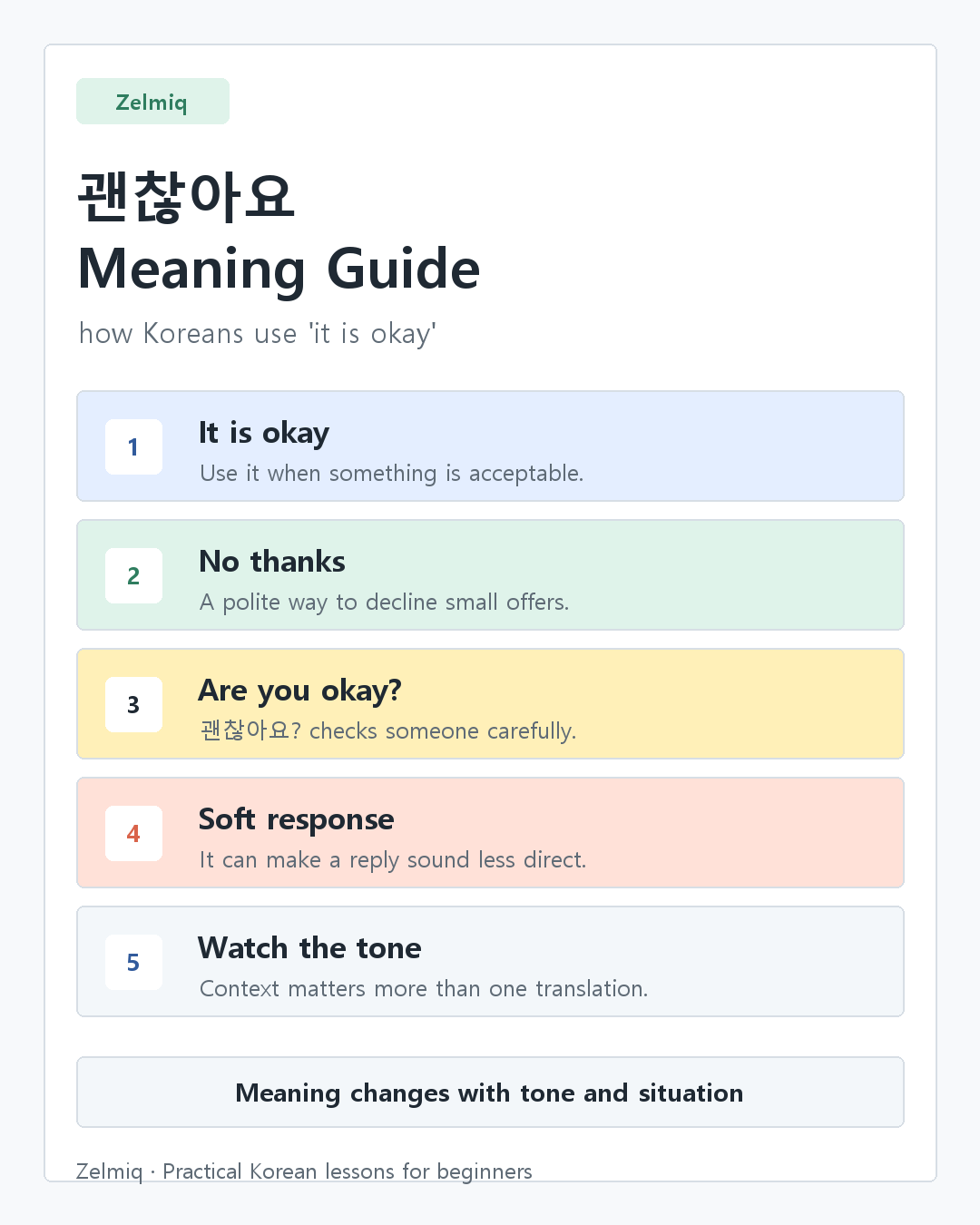
This is why 괜찮아요 meaning can feel confusing at first. English uses different phrases for different situations, but Korean can use 괜찮아요 in many everyday moments. Once you understand the feeling behind it, you will hear it everywhere in Korean conversations.
What Does 괜찮아요 Mean?
괜찮아요 comes from 괜찮다, which means “to be okay,” “to be fine,” or “to be alright.” The polite form is 괜찮아요, so it is safe to use in many everyday situations.
You can use it when someone asks if you are okay:
괜찮아요?
Are you okay?
네, 괜찮아요.
Yes, I’m okay.
You can also use it when something is acceptable:
이 자리 괜찮아요?
Is this seat okay?
네, 괜찮아요.
Yes, it’s fine.
The phrase is short, polite, and natural. That is why it appears so often in real Korean life.
괜찮아요 Can Mean “I’m Okay”
The most direct use of 괜찮아요 is to say that you are okay.
Imagine you trip a little, and someone asks:
괜찮아요?
Are you okay?
You can answer:
네, 괜찮아요.
Yes, I’m okay.
This is similar to English. But Korean speakers may use 괜찮아요 even when they are slightly uncomfortable, because it can also soften the mood. It can mean, “Don’t worry about me” or “It’s not a big problem.”
For example, if someone accidentally bumps into you and apologizes, you can say:
괜찮아요.
It’s okay.
This tells the person that you are not angry. It is a gentle and polite response.
괜찮아요 Can Also Mean “No Thanks”
Here is the part that confuses many beginners: 괜찮아요 can also mean “No thanks.”
Imagine someone offers you more food:
더 드릴까요?
Would you like more?
You can say:
괜찮아요.
No, I’m okay. / No thanks.
In this situation, 괜찮아요 does not mean “the food is okay.” It means you are fine without more. The feeling is polite refusal.
This is very common in Korean. Instead of saying a direct “no,” people often use softer expressions. 괜찮아요 sounds less sharp than simply saying 아니요. It helps the conversation feel smooth and considerate.
Another example:
봉투 필요하세요?
Do you need a bag?
괜찮아요.
No thanks.
At a store or cafe, this is a very natural answer.
How to Use 괜찮아요 Naturally
The key to using 괜찮아요 naturally is context. The same phrase can mean different things depending on the question.
If someone asks about your condition, 괜찮아요 means “I’m okay.”
If someone apologizes, 괜찮아요 means “It’s okay” or “No problem.”
If someone offers something, 괜찮아요 often means “No thanks.”
Let’s compare:
A: 많이 아파요?
Are you very sick?
B: 괜찮아요.
I’m okay.
A: 죄송합니다.
I’m sorry.
B: 괜찮아요.
It’s okay.
A: 물 더 드릴까요?
Would you like more water?
B: 괜찮아요.
No thanks.
If you want to sound a little warmer, you can add 정말:
정말 괜찮아요.
It’s really okay.
If you want to be more casual with close friends, you may hear:
괜찮아.
It’s okay. / I’m okay.
But beginners should use 괜찮아요 first because it is polite and widely useful.
One small warning: because 괜찮아요 can be a polite refusal, listen carefully to tone and situation. If someone says 괜찮아요 while gently waving their hand, they probably mean “No thanks.” If they say it after falling or making a mistake, they probably mean “I’m okay” or “It’s fine.”
Learning 괜찮아요 gives you more than one phrase. It gives you a window into Korean communication style: soft, indirect, and considerate. It is a small expression, but it can make your Korean sound much more natural.
FAQ
Q. Can I use this expression with anyone?
It depends on politeness level and relationship. When speaking to strangers or older people, choose the more polite form first.
Q. Why does one Korean expression have several English meanings?
Korean expressions often depend on context. The same phrase can change meaning depending on tone, situation, and relationship.
Q. How should I practice natural usage?
Read the example sentences aloud and imagine who you are speaking to. This helps you connect the phrase with the right social situation.