Many beginners want to learn Hangul fast, but fast should not mean rushed. The Korean alphabet is logical, but your brain still needs repeated contact with the shapes, sounds, and syllable blocks. A realistic goal is not to become fluent in seven days. The better goal is to read simple Korean words without panicking or depending on romanization.
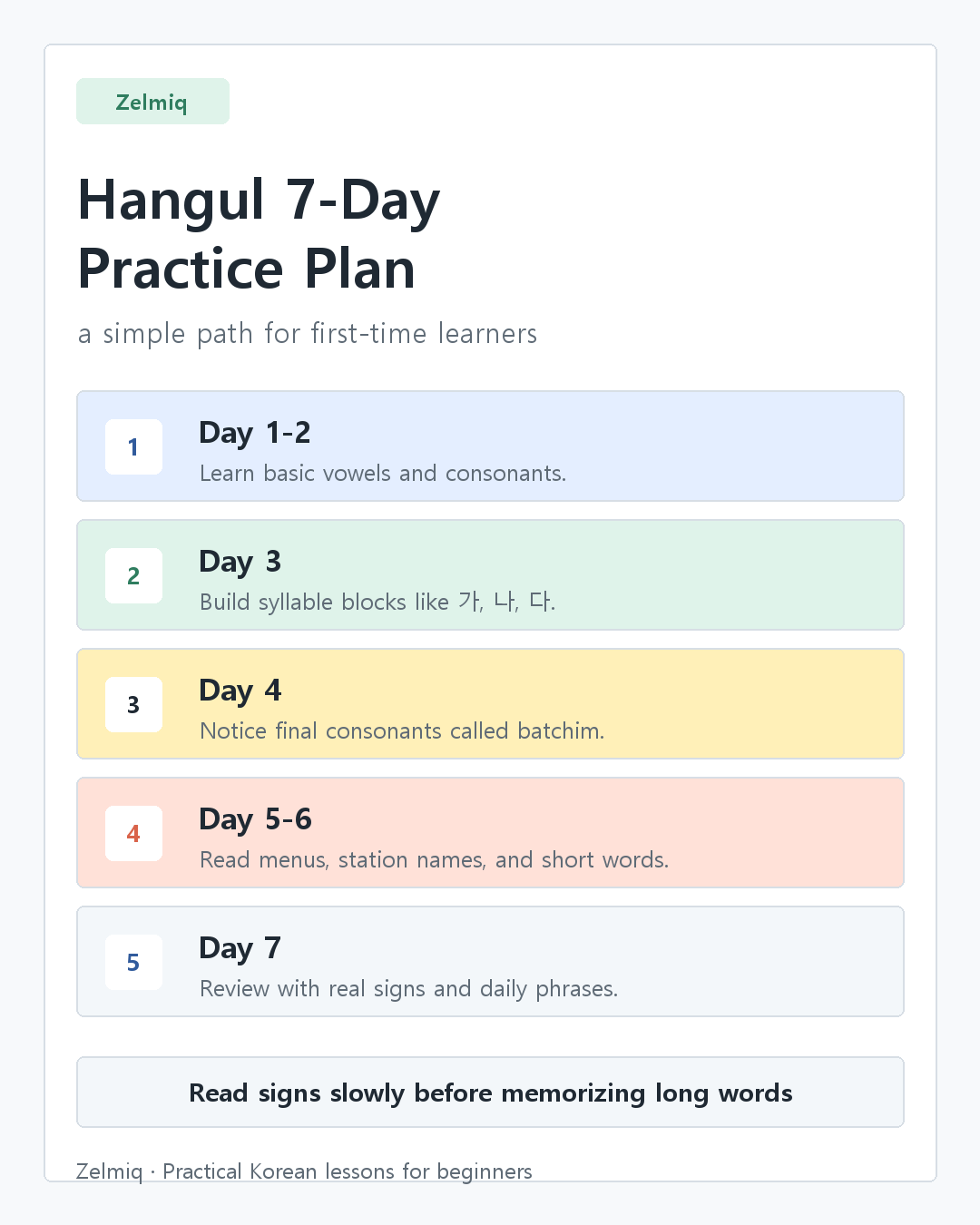
This 7-day plan is designed for complete beginners. It keeps each day small enough to finish, but structured enough to build real reading confidence. If you already know some letters, use it as a clean review plan.
Quick answer
To learn Hangul fast, study vowels and consonants separately first, then practice syllable blocks every day. Avoid relying on romanization after day two. Read short real words aloud, check batchim carefully, and review in short daily sessions.
Why Hangul Should Come Before Vocabulary Lists
Romanization can help for a few minutes, but it quickly becomes a habit that slows you down. Korean is written in blocks, not in a straight alphabet line like English. For example, 한 is made from ㅎ + ㅏ + ㄴ. If you only memorize the romanized form han, you miss how Korean syllables are built.
Hangul also helps pronunciation. Some Korean sounds do not match English spelling neatly. Once you read the letters directly, you can notice patterns such as batchim, double consonants, and vowel differences more accurately. If batchim feels confusing later, use this guide after day four: Korean batchim for beginners.
The 7-Day Hangul Practice Plan
| Day | Main Focus | Practice Goal |
|---|---|---|
| Day 1 | Basic vowels | Recognize and read ㅏ, ㅓ, ㅗ, ㅜ, ㅡ, ㅣ |
| Day 2 | Basic consonants | Read simple consonant-vowel blocks like 가, 나, 다 |
| Day 3 | Syllable blocks | Understand left-to-right and top-to-bottom block shapes |
| Day 4 | Batchim | Notice final consonants such as ㄴ, ㅁ, ㄹ, ㅇ |
| Day 5 | Double and tense sounds | Compare sounds like ㄱ, ㅋ, ㄲ and ㅅ, ㅆ |
| Day 6 | Real word reading | Read short words without romanization |
| Day 7 | Review and speed | Read slowly but smoothly for 10 minutes |
Day 1: Learn the Core Vowels
Start with the basic vowels: ㅏ, ㅓ, ㅗ, ㅜ, ㅡ, and ㅣ. Do not try to memorize every vowel combination on the first day. Your job is to recognize the shapes quickly and say the sounds out loud. Write each vowel ten times, then read it without looking at your notes.
A simple trick is to group the vowels by shape. ㅏ and ㅓ are vertical vowels. ㅗ and ㅜ are horizontal vowels. ㅡ and ㅣ are simple line vowels. This visual grouping will help when you build syllable blocks on day three.
Day 2: Add the Basic Consonants
On the second day, add common consonants such as ㄱ, ㄴ, ㄷ, ㄹ, ㅁ, ㅂ, ㅅ, ㅇ, ㅈ, ㅎ. You do not need perfect pronunciation yet. First, learn to recognize them inside blocks. Practice reading simple blocks: 가, 나, 다, 라, 마, 바, 사, 아, 자, 하.
Notice that ㅇ is silent at the beginning of a syllable, as in 아. At the end of a syllable, it has an ng sound. This one letter confuses many beginners, so keep it visible in your notes.
Day 3: Understand Korean Syllable Blocks
Korean letters combine into syllable blocks. A block usually has a beginning consonant and a vowel. Some blocks also have a final consonant. The block shape changes depending on whether the vowel is vertical or horizontal.
| Block Type | Example | How to Read It |
|---|---|---|
| Consonant + vertical vowel | 가 | ㄱ + ㅏ |
| Consonant + horizontal vowel | 고 | ㄱ + ㅗ |
| Consonant + vowel + final consonant | 간 | ㄱ + ㅏ + ㄴ |
| Silent ㅇ + vowel | 아 | ㅇ + ㅏ |
For Korean sentence structure later, you will need to recognize words quickly, not decode every letter slowly. After this day, also read Korean word order explained so you understand why reading Korean words in blocks matters.
Day 4: Learn Batchim Without Overloading Yourself
Batchim is a final consonant at the bottom of a syllable block. In the word 한, ㄴ is the batchim. In 말, ㄹ is the batchim. Beginners often skip the final sound because it is visually smaller, but batchim can change meaning and pronunciation.
On day four, practice only common final consonants: ㄴ, ㅁ, ㄹ, ㅇ, ㄱ, ㅂ, ㄷ. Read slowly. Your goal is not speed. Your goal is to stop ignoring the bottom of the block.
Day 5: Compare Similar Sounds
Korean has sound groups that may feel close to English learners: ㄱ, ㅋ, ㄲ; ㄷ, ㅌ, ㄸ; ㅂ, ㅍ, ㅃ; ㅈ, ㅊ, ㅉ; ㅅ, ㅆ. Do not force perfect pronunciation in one day. Instead, train your eyes to notice the difference first.
Make a small comparison sheet. Write 가, 카, 까. Then write 다, 타, 따. Read them aloud and listen to native examples from a reliable source. The Online King Sejong Institute offers free online Korean learning resources for foreign learners, and its course list includes introductory and beginner Korean courses.
Day 6: Read Real Words, Not Random Blocks
Random syllables are useful at the beginning, but real words make practice stick. Read simple words like 한국, 사람, 물, 집, 학교, 커피, 택시, 지하철. Say each word slowly. Cover the romanization if your study material shows it.
Connect reading practice with useful phrases. For example, after you can read 안녕하세요, practice it in context with Korean greetings for beginners. Reading becomes easier when the words have a real situation attached.
Day 7: Review With a 15-Minute Routine
On the final day, do not add too much new material. Review instead. Spend five minutes reading vowels and consonants, five minutes reading syllable blocks with batchim, and five minutes reading real words or short phrases. This keeps your practice focused and prevents fatigue.
Daily routine after the first week
Read five new Korean words, write them once by hand, say them aloud, and review yesterday’s words. Ten minutes a day is better than one long session once a week.
Common Mistakes When Learning Hangul Fast
- Depending on romanization too long. Use it only as a temporary bridge.
- Ignoring batchim. Always check whether a syllable has a final consonant.
- Memorizing shapes without sound. Say every letter and word out loud.
- Trying to master every sound rule immediately. Learn the alphabet first, then sound changes gradually.
- Studying only isolated letters. Move to real words as soon as possible.
FAQ
Can I really learn Hangul in one week?
You can learn to recognize and read basic Hangul in one week if you practice daily. Pronunciation, speed, and natural reading will take longer.
Should I memorize romanization first?
No. Romanization can help briefly, but it should not become your main reading system. Learn the Hangul letters directly as early as possible.
What should I study after Hangul?
After Hangul, learn basic greetings, word order, particles, and common daily phrases. This gives you grammar and useful communication at the same time.