Korean public transportation is clean, fast, and convenient, but it also has quiet social rules. If you are a foreigner using the subway or bus in Korea, learning a few etiquette points will help you move more comfortably and avoid awkward situations.
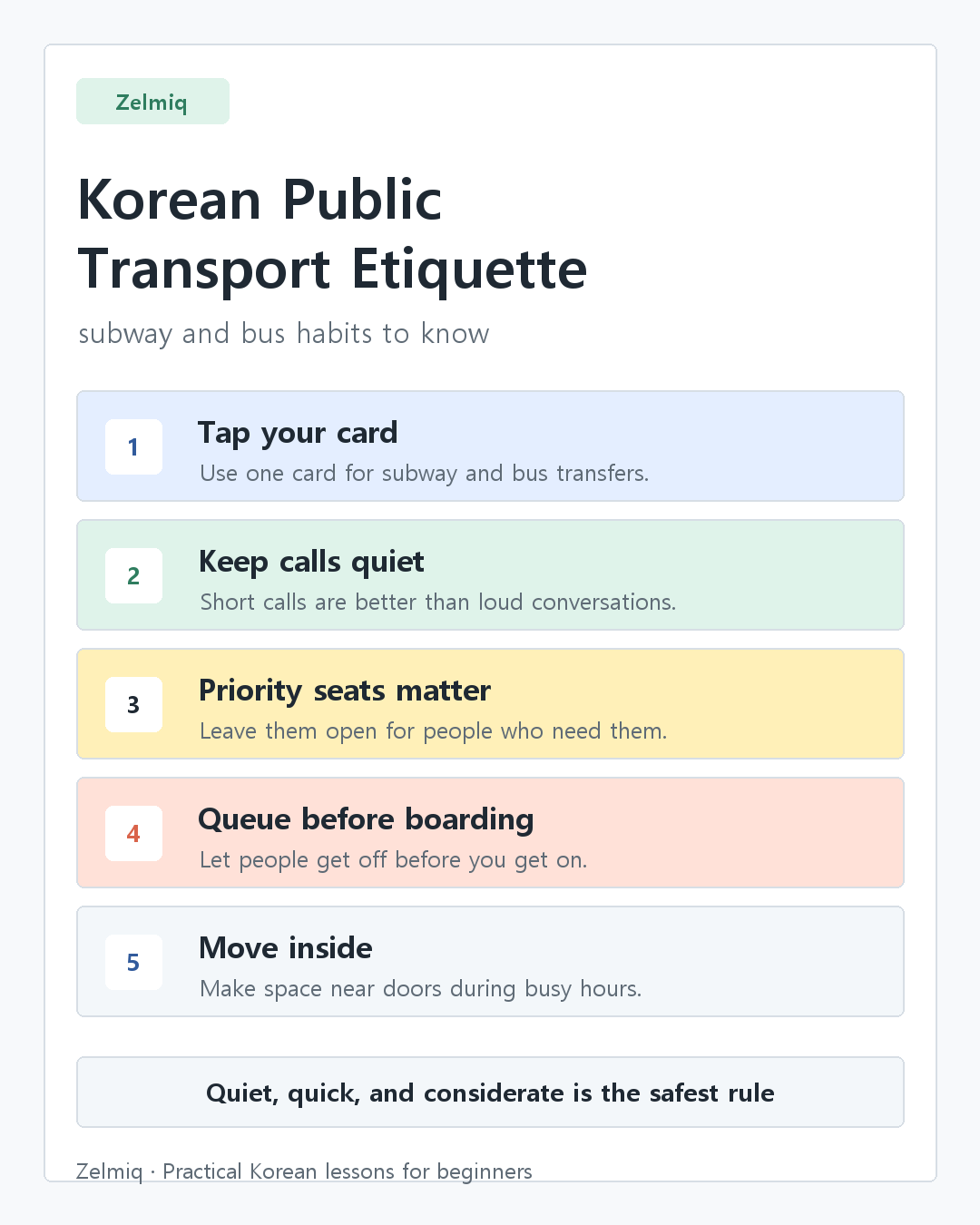
This guide explains Korean public transportation etiquette in a practical way: how to board, where to stand, what to do with your bag, when to use priority seats, and which Korean phrases can help when you need to move through a crowded train or bus.
Quick answer
On Korean subways and buses, stay quiet, let passengers get off before boarding, keep bags from blocking people, respect priority seats, and tap your transportation card correctly when entering and exiting.
Why Public Transportation Etiquette Matters in Korea
Subways and buses are part of daily life in Korea. Office workers, students, older people, parents, and travelers often share the same crowded space. Because so many people use public transportation every day, small behaviors matter. Blocking a door, speaking loudly, or standing in the wrong place can affect many people quickly.
The goal is not to act perfectly. The goal is to understand the local rhythm. If you follow the basic flow, most rides become easy: wait in line, let people exit, board calmly, move inside, keep noise low, and prepare before your stop.
Subway Etiquette: Let People Exit First
At subway doors, people usually wait on both sides of the door area so passengers inside can exit through the middle. Do not stand directly in front of the door. When the train arrives, wait until people get off first, then board. This is one of the most important subway manners in Korea.
If the train is crowded and you are standing near the door, step out briefly to let people exit, then get back on. This may feel strange at first, but it is normal in crowded Korean subway stations.
| Situation | Good Etiquette | Avoid This |
|---|---|---|
| Waiting for subway | Stand to the side and queue | Blocking the door before people exit |
| Crowded doorway | Step out and re-enter if needed | Refusing to move when others need to get off |
| Inside the car | Move away from the door when possible | Standing at the door for the whole ride |
| Getting off | Prepare before your station | Pushing suddenly at the last second |
Bus Etiquette: Enter Front, Exit Back
Seoul’s public transportation guidance explains that buses in Korea are generally designed for passengers to enter through the front door and exit through the back door. Some people may do the opposite in real life, but following the standard flow helps passengers move efficiently in a narrow space.
When you board, tap your transportation card at the front. When you get off, tap again if the bus uses a card reader near the exit. Tapping out can matter for transfers and fare calculation. If you are still learning how transportation cards work, read Tmoney card in Korea: a practical guide for foreigners.
Priority Seats: Be Careful Even If They Are Empty
Korean subways and buses have priority seats for older adults, pregnant passengers, passengers with disabilities, and people who need extra support. On the subway, these seats are often clearly marked. Some trains also have seats or areas for pregnant passengers.
Foreign visitors sometimes sit in priority seats because they are empty. In Korea, many people avoid those seats even when the train is not full. The safest habit is simple: if you do not need the seat, choose another place to sit or stand.
Keep Noise Low
Korean subways and buses are often quieter than many visitors expect. Loud phone calls, speakerphone, videos without earphones, or very loud group conversations can feel rude. You do not need to be silent, but keep your voice low and use earphones for audio.
This quietness is especially noticeable during commuting hours. Many people are tired, studying, or resting. If you need to take a call, speak briefly and softly. If the call can wait, send a message instead.
Bags, Backpacks, and Suitcases
Large bags can block people in crowded trains and buses. If you are wearing a backpack, take it off or move it to the front of your body when the space is crowded. Keep suitcases close to you and avoid leaving them in the doorway. This is especially important near airport train lines, major stations, and rush-hour subway cars.
If you are traveling with luggage, prepare your exit early. Do not wait until the door opens to lift a heavy bag or search for your stop. A little preparation makes the ride smoother for everyone around you.
Eating and Drinking on Public Transportation
It is best to avoid eating meals or messy snacks on Korean subways and buses. A closed bottle of water is usually not an issue, but food smells, spills, and trash can bother other passengers. If you buy food before boarding, keep it closed until you arrive.
This is also a practical habit. Crowded trains can stop suddenly, and buses can turn quickly. Spilling coffee or food on another passenger would be much more embarrassing than waiting a few minutes.
Useful Korean Phrases on Subways and Buses
| Korean | Meaning | When to Use It |
|---|---|---|
| 잠시만요 | Excuse me / just a moment | When moving through a crowd |
| 내릴게요 | I am getting off | When you need to pass people before your stop |
| 죄송합니다 | I am sorry | If you bump into someone |
| 여기 앉으세요 | Please sit here | When offering your seat |
| 지나갈게요 | I will pass through | When moving past someone politely |
For more subway-specific language, use Korean phrases on the subway. If you use taxis sometimes, Korean phrases in a taxi will also help with short destination and payment phrases.
Common Mistakes Foreigners Make
- Standing directly in front of subway doors. Wait to the side so people can exit first.
- Using priority seats casually. Avoid them unless you need them.
- Forgetting to tap out on the bus. Tap when exiting if there is a reader.
- Keeping a backpack on your back in a crowded car. Hold it in front or near your feet.
- Speaking too loudly. Keep conversations and calls quiet.
Simple Ride Checklist
- Check your route and stop before boarding.
- Wait to the side of subway doors or board the bus through the front.
- Tap your transportation card correctly.
- Move inside instead of blocking the door.
- Keep your bag close and your voice low.
- Prepare before your stop and say 잠시만요 if you need to pass.
Public transportation etiquette is not about memorizing a long rulebook. It is about making shared space easier for everyone. Once you learn the pattern, Korean subways and buses become one of the most convenient parts of daily life in Korea.
FAQ
Can I sit in priority seats in Korea if they are empty?
It is better not to sit there unless you need the seat. Many people in Korea leave priority seats open for older adults, pregnant passengers, passengers with disabilities, or anyone who needs extra support.
Should I tap my transportation card when getting off the bus?
Yes, if there is a card reader near the exit, tapping out is a good habit. It can affect transfer handling and fare calculation.
Is it rude to talk on the phone on Korean public transportation?
Short quiet calls may happen, but loud phone conversations are generally considered impolite. Messaging is usually better when possible.