If you are visiting or living in Korea, a Tmoney card is one of the easiest ways to use public transportation. You can use it on subways, buses, many taxis, and some stores that accept Tmoney payments. For many foreigners, it is simpler than buying a single ticket every time you ride the subway or bus.
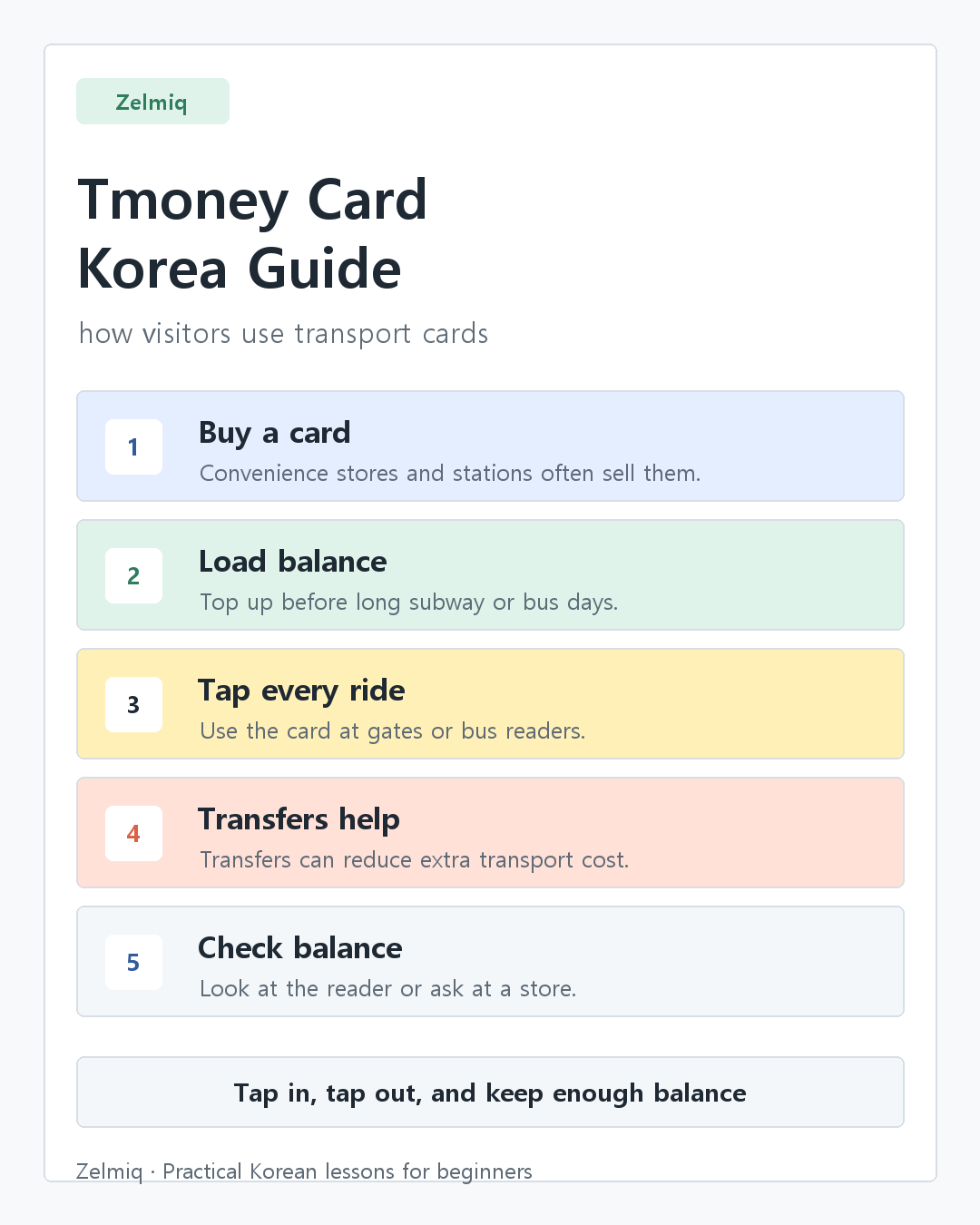
The short answer is this: if you will use public transportation in Korea more than once or twice, getting a transportation card is usually worth it. A regular Tmoney card is simple for most short trips. If you will travel around Seoul many times in a short period, you may also want to compare tourist transportation cards or the Climate Card before choosing.
This guide explains how the Tmoney card works, where to buy it, how to recharge it, how to use it naturally, and which Korean phrases are helpful when you are at a station, convenience store, taxi, or airport.
What Is a Tmoney Card?
A Tmoney card is a rechargeable transportation card used in Korea. You add money to the card first, then tap it when you ride public transportation. It is commonly used for subways, buses, some taxis, and certain affiliated stores.
According to VISITKOREA, Korean transportation cards such as Tmoney are prepaid cards that do not require an account and can make public transportation more convenient. VISITKOREA also notes that the Tmoney card has a large number of affiliated stores in Korea, which is one reason many travelers choose it.
Quick answer
A Tmoney card is best for foreigners who want a simple way to use Korean subways and buses without buying a ticket each time. Buy it, recharge it, tap when you enter, and tap again when you leave or transfer.
Where Can You Buy a Tmoney Card in Korea?
You can usually buy a Tmoney card at convenience stores and transportation-related locations. VISITKOREA lists convenience stores nationwide and information centers in Seoul subway stations as common retail locations for Tmoney cards. Tmoney’s foreigner card page also lists convenience stores and bus ticket offices at Incheon Airport as places where travelers may find foreigner-friendly Tmoney products.
For a first-time visitor, the simplest option is usually a convenience store. Stores such as CU, GS25, 7-ELEVEN, and emart24 are common in Korea. If you are arriving at the airport, you can also look for transportation card options before taking a train, bus, or taxi into the city.
| Place | Good For | Beginner Tip |
|---|---|---|
| Convenience store | Buying and recharging a card | Ask for a transportation card or show the word 티머니. |
| Subway station | Recharging and checking balance | Look for recharge machines near ticket gates. |
| Airport | Starting your trip immediately | Compare Tmoney, tourist passes, and airport transport options. |
How to Recharge a Tmoney Card
After buying the card, you need to add money to it. This is usually called recharging, topping up, or loading the card. In Korean, you may see the word 충전, which means recharge.
You can recharge at many convenience stores and subway station machines. Some machines may support several languages, but if you feel unsure, a convenience store can be easier. Hand the card to the cashier and say a simple amount.
Useful Korean Phrases for Recharging
- 티머니 충전해 주세요.
Please recharge my Tmoney card. - 만 원 충전해 주세요.
Please add 10,000 won. - 잔액 확인해 주세요.
Please check the balance.
If convenience store phrases feel difficult, start with Korean phrases at a convenience store. That guide explains simple store phrases that are useful beyond transportation cards.
How to Use Tmoney on the Subway and Bus
Using a Tmoney card is simple: tap the card on the reader when you enter and tap again when you exit. On the subway, you tap at the gate. On buses, you tap when boarding and usually tap again when getting off. Tapping out is important because it helps calculate fares and transfers correctly.
A common mistake is forgetting to tap out on the bus. Even if other passengers move quickly, try to remember the second tap before you get off. This is especially important if you will transfer to another bus or subway line.
If you are new to Korean public transportation, also read Korean Phrases on the Subway. It explains words such as 출구, 환승, and 역, which appear often in stations.
Tmoney vs Climate Card vs Tourist Cards
Tmoney is not the only transportation card option in Korea. The best choice depends on your travel style. A regular Tmoney card is flexible and easy. A Climate Card may be useful if you will use eligible public transportation in Seoul very often during a fixed period. Tourist cards such as Mpass or other travel cards may also offer benefits depending on your itinerary.
| Card Type | Best For | Watch Out For |
|---|---|---|
| Regular Tmoney card | Most travelers and residents who want flexible transit payment | You need to recharge before use. |
| Foreigner or travel Tmoney products | Visitors who want tourist-focused benefits | Benefits can change, so compare before buying. |
| Climate Card | People using Seoul public transportation frequently for a fixed period | Coverage and pass rules matter. Check official details first. |
The Seoul Metropolitan Government describes the Climate Card as a transportation card that provides unlimited use of eligible public transportation for a fixed period after charging. Tmoney’s Climate Card guide for foreigners also lists short-term pass options. However, coverage rules and payment conditions can matter, so check the official page before choosing it over a regular Tmoney card.
Can You Use Tmoney in a Taxi?
Many taxis in Korea accept transportation cards, but you should still check the payment reader or ask if you are unsure. If you are nervous about taxi conversations, learn a few short phrases first. The most useful pattern is destination plus 가 주세요, meaning “please go to.”
For practical taxi language, see Korean Phrases in a Taxi. It covers phrases such as 여기로 가 주세요 and 카드 돼요?
Common Mistakes Foreigners Make with Tmoney
- Not recharging enough before a trip. Check your balance before a long route.
- Forgetting to tap out. Tap when you exit buses and subway gates.
- Assuming every card works everywhere. Check the accepted card logo or official coverage.
- Choosing a pass without checking travel style. Unlimited passes are not always cheaper for light users.
- Not keeping some cash. Some recharge situations may still be easier with Korean won cash.
Useful Korean Words for Transportation Cards
| Korean | Meaning | Where You May See It |
|---|---|---|
| 티머니 | Tmoney | Card package, store, payment reader |
| 교통카드 | Transportation card | Convenience store, station machine |
| 충전 | Recharge / top up | Subway machine, store counter |
| 잔액 | Balance | Receipt, card reader, recharge machine |
| 환승 | Transfer | Subway signs, bus/subway routes |
Simple Step-by-Step Plan
- Buy a Tmoney card at a convenience store, station, or airport location.
- Recharge it with enough money for your first few rides.
- Tap the card when entering the subway gate or boarding the bus.
- Tap again when exiting or getting off.
- Check your balance before long routes or late-night travel.
- Compare Climate Card or tourist cards only if you will ride public transportation very often.
If you are arriving in Korea soon, the airport is often the first place where transportation phrases become useful. You may also want to read Korean Phrases at the Airport before your trip.
FAQ
Do I need a Tmoney card in Korea?
You do not legally need one, but it is very convenient if you will use subways or buses. It saves time compared with buying single-use tickets repeatedly.
Can foreigners buy a Tmoney card?
Yes. Foreigners can buy transportation cards in Korea. Some products are specifically designed for foreign visitors, but a regular Tmoney card is also widely used.
Where is the easiest place to recharge a Tmoney card?
For beginners, a convenience store is often the easiest. Subway station recharge machines are also common and useful once you understand the screen options.
Is the Climate Card better than Tmoney?
Not always. The Climate Card can be useful for frequent eligible transportation use in Seoul, but a regular Tmoney card may be simpler for casual travelers. Compare your route, travel period, and official coverage before choosing.