Many Korean beginners get confused by 에 and 에서 because both can be connected to places. You may see sentences like 학교에 가요 and 학교에서 공부해요, and wonder why the particle changes.
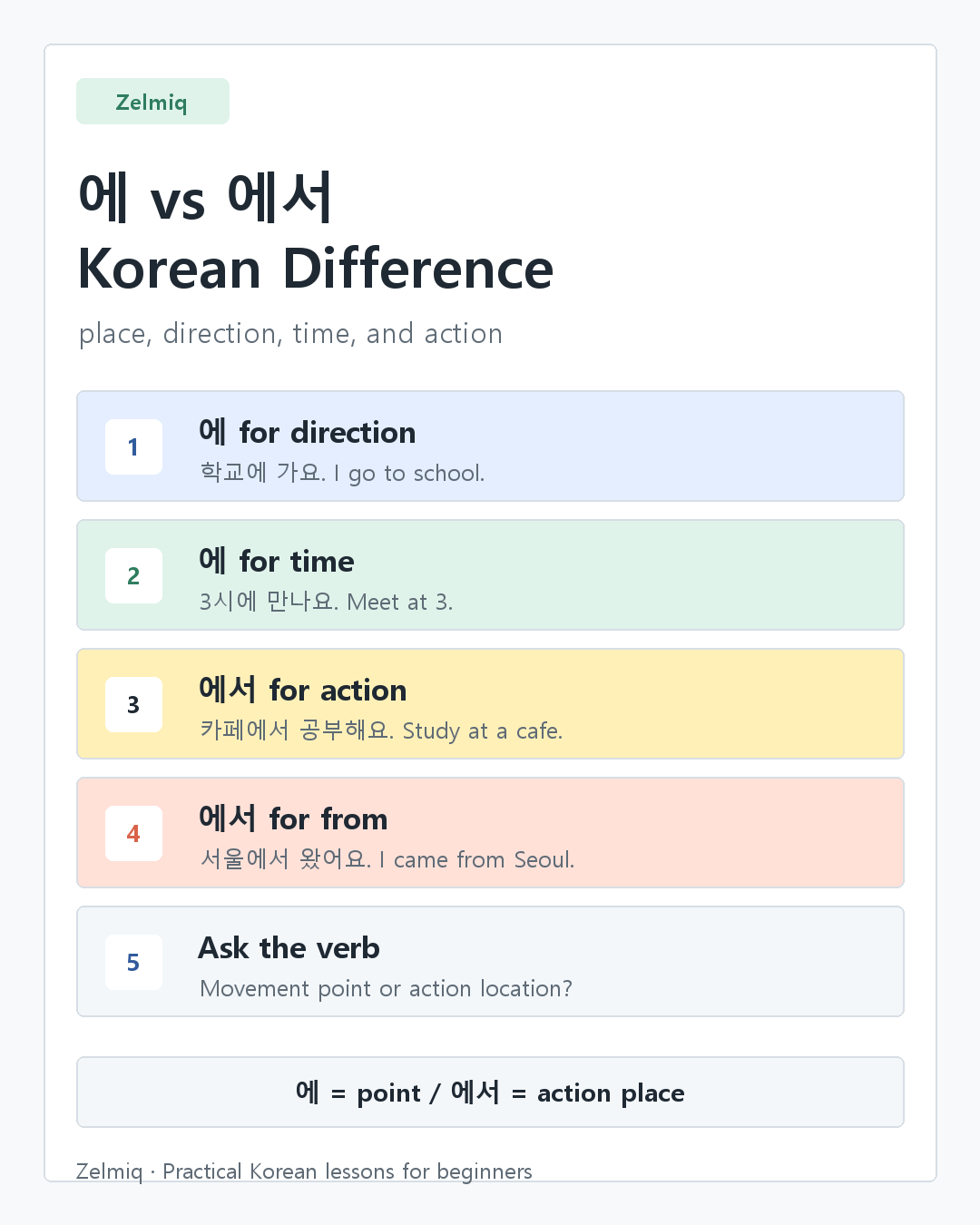
Here is the simple answer: 에 often points to a destination, time, or location of existence. 에서 usually marks the place where an action happens. Once you understand this difference, Korean location particles become much easier.
The Basic Difference Between 에 and 에서
Think of 에 as pointing to a place, direction, or fixed point. It often answers “to where?”, “at what time?”, or “where something exists?”
Think of 에서 as the action place. It often answers “where does the action happen?”
Compare these two sentences:
학교에 가요.
I go to school.
학교에서 공부해요.
I study at school.
In the first sentence, school is the destination. You are moving toward school. So Korean uses 에.
In the second sentence, studying is happening at school. School is the action location. So Korean uses 에서.
This is the core difference. If you remember only one thing, remember this: movement destination = 에, action location = 에서.
Use 에 for Destination, Time, and Existence
The particle 에 is used in several common ways. The first one is destination.
집에 가요.
I go home.
회사에 와요.
I come to the office.
한국에 가고 싶어요.
I want to go to Korea.
In these sentences, the place is where someone is going or coming. That is why 에 is used.
The second use is time.
3시에 만나요.
Let’s meet at 3 o’clock.
월요일에 수업이 있어요.
I have class on Monday.
주말에 쉬어요.
I rest on the weekend.
Here, 에 marks a time point. In English, it may translate as “at,” “on,” or “in,” depending on the sentence.
The third use is existence. Korean verbs like 있다 and 없다 often use 에.
책이 책상에 있어요.
The book is on the desk.
친구가 집에 없어요.
My friend is not at home.
카페에 사람이 많아요.
There are many people at the cafe.
In these cases, the sentence is not focusing on an action happening there. It is showing where something or someone exists.
Use 에서 for Actions Happening in a Place
Now let’s look at 에서. Use 에서 when someone does something in a place.
카페에서 커피를 마셔요.
I drink coffee at a cafe.
도서관에서 공부해요.
I study at the library.
식당에서 밥을 먹어요.
I eat at a restaurant.
공원에서 산책해요.
I take a walk in the park.
In all these sentences, the place is not just a destination. It is where the action happens.
This is why 집에 가요 and 집에서 쉬어요 are different.
집에 가요 means “I go home.” Home is the destination.
집에서 쉬어요 means “I rest at home.” Resting happens at home.
The place may be the same, but the grammar changes because the role of the place changes.
Easy Practice Examples for Beginners
Let’s practice with simple pairs.
학교에 가요.
I go to school.
학교에서 공부해요.
I study at school.
카페에 와요.
I come to the cafe.
카페에서 친구를 만나요.
I meet a friend at the cafe.
서울에 살아요.
I live in Seoul.
서울에서 일해요.
I work in Seoul.
You may notice that 살아요 can sometimes feel tricky. Many learners expect 에서 because living is an activity. But Korean commonly uses 에 살아요 because it describes where someone lives or is located in life.
So you can say:
저는 서울에 살아요.
I live in Seoul.
For beginners, do not worry about every exception at once. Start with the main rule: 에 for destination, time, or existence; 에서 for action location.
A helpful question is:
“Am I going there?” → Use 에.
“Is something happening there?” → Use 에서.
“Is something located there?” → Use 에.
Korean particles may feel small, but they carry important meaning. The good news is that 에 and 에서 become natural with repeated examples. Once you notice the role of the place in each sentence, the difference starts to feel much clearer.
FAQ
Q. Is this grammar point important for beginners?
Yes. 에 vs 에서 in Korean: The Simple Difference Beginners Need to Know covers a pattern that appears often in beginner Korean, so it is worth learning early with simple examples.
Q. Should I memorize every rule at once?
No. Learn the basic meaning first, then practice with short sentences. Korean grammar becomes clearer when you see it in repeated real examples.
Q. What is the best way to practice?
Make three short sentences about your own life. This helps you move from recognition to actual use.