Convenience stores are everywhere in Korea.
They are useful for snacks, water, transit card top-ups, quick meals, phone chargers, umbrellas, and late-night basics. But if you are new to Korean, even a simple payment moment can feel fast.
This guide gives you practical Korean convenience store phrases for paying, asking for a bag, getting a receipt, using the microwave, and asking simple questions.
Quick Phrases
Start with these short phrases:
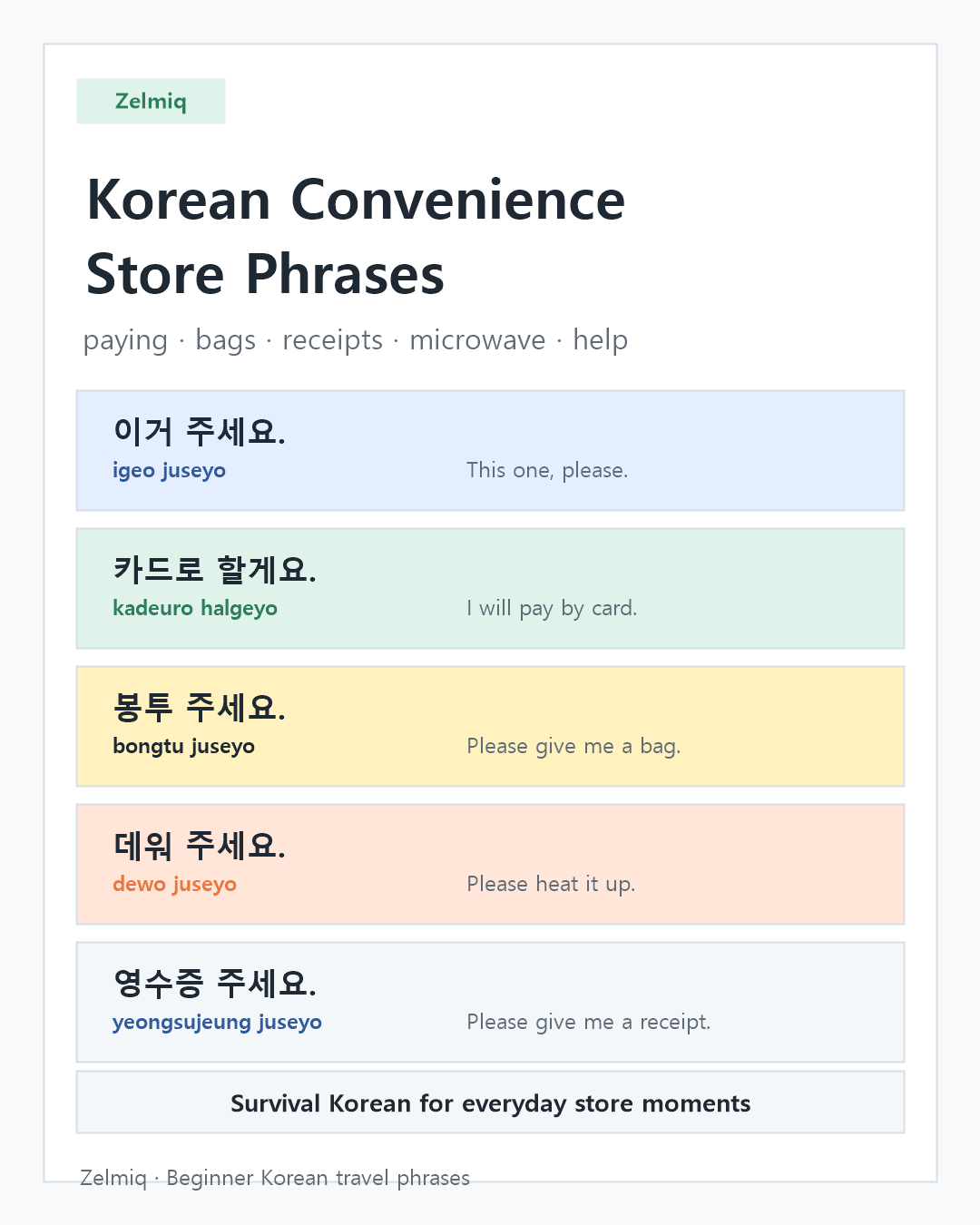
이거 주세요.
igeo juseyo
This one, please.

카드로 할게요.
kadeuro halgeyo
I will pay by card.

봉투 주세요.
bongtu juseyo
Please give me a bag.

영수증 주세요.
yeongsujeung juseyo
Please give me a receipt.

데워 주세요.
dewo juseyo
Please heat it up.

이거 얼마예요?
igeo eolmayeyo?
How much is this?

교통카드 충전돼요?
gyotong kadeu chungjeon dwaeyo?
Can I top up my transit card?

어디에 있어요?
eodie isseoyo?
Where is it?

괜찮아요.
gwaenchanayo
It is okay / No, thanks.

도와주세요.
dowajuseyo
Please help me.
1. Choosing and Paying
이거 주세요.
Romanization:
igeo juseyoMeaning:
This one, please.Use this when you point to an item or put something on the counter.
카드로 할게요.
Romanization:
kadeuro halgeyoMeaning:
I will pay by card.Many convenience stores in Korea accept cards, but it is still useful to say this phrase clearly.
현금으로 할게요.
Romanization:
hyeongeumeuro halgeyoMeaning:
I will pay by cash.Use this if you want to pay with cash.
2. Bags and Receipts
봉투 주세요.
Romanization:
bongtu juseyoMeaning:
Please give me a bag.In Korea, bags may cost extra. If you need one, ask clearly.
영수증 주세요.
Romanization:
yeongsujeung juseyoMeaning:
Please give me a receipt.If you do not need a receipt, you can say:
괜찮아요.
gwaenchanayo
It is okay / No, thanks.
3. Heating Food
데워 주세요.
Romanization:
dewo juseyoMeaning:
Please heat it up.Use this for lunch boxes, rice balls, or ready-to-eat meals that can be heated.
전자레인지 어디예요?
Romanization:
jeonja reinji eodiyeyo?Meaning:
Where is the microwave?Some stores let customers use the microwave themselves.
4. Asking About Items
이거 얼마예요?
Romanization:
igeo eolmayeyo?Meaning:
How much is this?Use this when the price is unclear.
물 어디에 있어요?
Romanization:
mul eodie isseoyo?Meaning:
Where is the water?You can replace 물 with another item.
Examples:
우산 어디에 있어요?
usan eodie isseoyo?
Where are the umbrellas?

충전기 어디에 있어요?
chungjeongi eodie isseoyo?
Where are the chargers?
5. Transit Card Top-up
교통카드 충전돼요?
Romanization:
gyotong kadeu chungjeon dwaeyo?Meaning:
Can I top up my transit card?Some convenience stores can top up transportation cards. If the store cannot do it, staff may point you elsewhere.
만 원 충전해 주세요.
Romanization:
man won chungjeonhae juseyoMeaning:
Please top up 10,000 won.Change the amount as needed.
6. Simple Help
도와주세요.
Romanization:
dowajuseyoMeaning:
Please help me.Use this for simple store help, such as finding an item or understanding a machine.
For serious emergencies, contact local emergency services or ask a trusted person for help. Do not rely only on short travel phrases.
Mini Dialogue
Customer: 이거 주세요.
Staff: 봉투 필요하세요?
Customer: 네, 봉투 주세요.
Staff: 영수증 드릴까요?
Customer: 괜찮아요.
Staff: 네.
Customer: 감사합니다.
Meaning:
Customer: This one, please.
Staff: Do you need a bag?
Customer: Yes, please give me a bag.
Staff: Would you like a receipt?
Customer: No, thanks.
Staff: Okay.
Customer: Thank you.
Related Reading
- Start Here: Beginner Korean Path
- Survival Korean Starter Checklist
- Useful Korean Cafe Phrases for Beginners
- Korean Cafe Etiquette for Foreigners
- Korean Restaurant Phrases for Beginners
- Korean Taxi and Transport Phrases for Beginners
Free Checklist
Want a simple phrase checklist for your first week in Korea?
Download the free Survival Korean Starter Checklist. It includes practical Korean phrases for cafes, restaurants, transport, shopping, and help situations.
Final Tip
Convenience store Korean does not need to be long.
Start with 주세요, 카드로 할게요, 봉투 주세요, and 괜찮아요. These short phrases cover many simple store situations.
Disclaimer
Romanization is only a pronunciation aid. Learning Hangul will help you read signs, products, prices, and place names more accurately. For emergencies, medical needs, legal issues, or serious safety problems, use official help channels and do not rely only on simple travel phrases.