Pharmacies in Korea can be useful when you need simple over-the-counter help, basic supplies, or a pharmacist’s guidance.
But if you are new to Korean, it can be hard to explain what you need quickly.
This guide gives you simple Korean pharmacy phrases for asking for help, mentioning basic symptoms, explaining allergies, and asking how to use something. It is language practice only, not medical advice.
This article does not recommend any medicine, dosage, diagnosis, or treatment.
Important Safety Note
If your situation is serious, urgent, or unclear, do not rely only on short travel phrases.
Ask a qualified medical professional, contact local emergency services, or get help from a trusted Korean speaker.
Quick Phrases
Use these phrases to start a conversation:
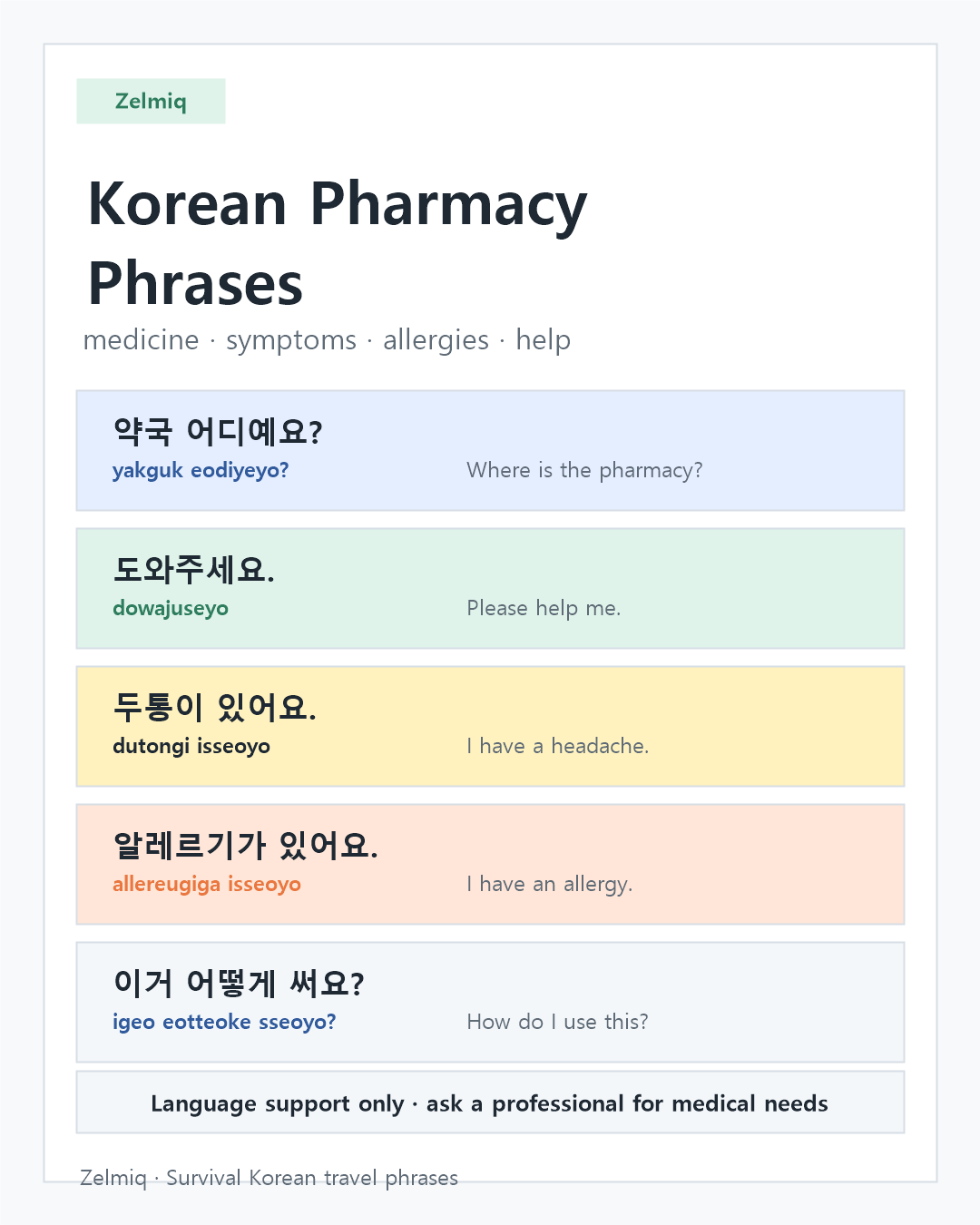
약국 어디예요?
yakguk eodiyeyo?
Where is the pharmacy?

도와주세요.
dowajuseyo
Please help me.

감기약 있어요?
gamgiyak isseoyo?
Do you have cold medicine?

두통이 있어요.
dutongi isseoyo
I have a headache.

배가 아파요.
baega apayo
My stomach hurts.

알레르기가 있어요.
allereugiga isseoyo
I have an allergy.

이거 어떻게 써요?
igeo eotteoke sseoyo?
How do I use this?

하루에 몇 번이에요?
harue myeot beoniyeyo?
How many times a day?

영어 가능하세요?
yeongeo ganeunghaseyo?
Do you speak English?

병원에 가야 해요?
byeongwone gaya haeyo?
Should I go to a hospital?
1. Finding a Pharmacy
약국 어디예요?
Romanization:
yakguk eodiyeyo?Meaning:
Where is the pharmacy?Use this when you are asking someone nearby where the pharmacy is.
근처에 약국 있어요?
Romanization:
geuncheoe yakguk isseoyo?Meaning:
Is there a pharmacy nearby?This is useful near a subway station, hotel, or convenience store.
2. Asking for Simple Help
도와주세요.
Romanization:
dowajuseyoMeaning:
Please help me.This is a broad phrase. You can use it when you are confused or need staff assistance.
영어 가능하세요?
Romanization:
yeongeo ganeunghaseyo?Meaning:
Do you speak English?If the situation is important, use translation support or ask someone you trust to help.
3. Explaining Basic Symptoms
These phrases help you describe simple symptoms. They do not replace medical advice.
두통이 있어요.
Romanization:
dutongi isseoyoMeaning:
I have a headache.목이 아파요.
Romanization:
mogi apayoMeaning:
My throat hurts.배가 아파요.
Romanization:
baega apayoMeaning:
My stomach hurts.열이 있어요.
Romanization:
yeori isseoyoMeaning:
I have a fever.If symptoms are strong, unusual, or getting worse, ask a medical professional instead of relying on phrase practice.
4. Asking About Medicine
감기약 있어요?
Romanization:
gamgiyak isseoyo?Meaning:
Do you have cold medicine?소화제 있어요?
Romanization:
sohwaje isseoyo?Meaning:
Do you have digestive medicine?밴드 있어요?
Romanization:
baendeu isseoyo?Meaning:
Do you have bandages?Do not choose medicine only from a phrase list. Ask the pharmacist and check instructions carefully.
5. Allergies and Safety
알레르기가 있어요.
Romanization:
allereugiga isseoyoMeaning:
I have an allergy.이 약 먹어도 돼요?
Romanization:
i yak meogeodo dwaeyo?Meaning:
Can I take this medicine?This phrase can start the conversation, but you should still explain your situation clearly and follow professional guidance.
저는 임신 중이에요.
Romanization:
jeoneun imsin jungiyeyoMeaning:
I am pregnant.If pregnancy, allergies, existing conditions, or current medicines are involved, ask a qualified professional before taking anything.
6. How to Use Something
이거 어떻게 써요?
Romanization:
igeo eotteoke sseoyo?Meaning:
How do I use this?하루에 몇 번이에요?
Romanization:
harue myeot beoniyeyo?Meaning:
How many times a day?식전에 먹어요?
Romanization:
sikjeone meogeoyo?Meaning:
Do I take it before meals?식후에 먹어요?
Romanization:
sik hue meogeoyo?Meaning:
Do I take it after meals?Always read the instructions and ask the pharmacist if you are unsure.
Mini Dialogue
Customer: 안녕하세요. 감기약 있어요?
Pharmacist: 증상이 어떻게 되세요?
Customer: 목이 아파요. 열도 있어요.
Pharmacist: 알레르기 있으세요?
Customer: 네, 알레르기가 있어요.
Pharmacist: 어떤 알레르기예요?
Customer: 영어 가능하세요?
Meaning:
Customer: Hello. Do you have cold medicine?
Pharmacist: What are your symptoms?
Customer: My throat hurts. I also have a fever.
Pharmacist: Do you have allergies?
Customer: Yes, I have an allergy.
Pharmacist: What allergy is it?
Customer: Do you speak English?
Related Reading
- Start Here: Beginner Korean Path
- Survival Korean Starter Checklist
- Useful Korean Cafe Phrases for Beginners
- Korean Cafe Etiquette for Foreigners
- Korean Restaurant Phrases for Beginners
- Korean Taxi and Transport Phrases for Beginners
- Korean Convenience Store Phrases for Beginners
Free Checklist
Want a simple phrase checklist for your first week in Korea?
Download the free Survival Korean Starter Checklist. It includes practical Korean phrases for cafes, restaurants, transport, shopping, and help situations.
Final Tip
For pharmacy situations, short phrases can help you start the conversation.
But if the situation is serious or unclear, do not rely only on simple Korean. Ask a pharmacist, doctor, emergency service, or trusted person for help.
Disclaimer
This article is for language learning and travel communication only. It is not medical advice, diagnosis, or treatment guidance. Medicine use, allergies, pregnancy, chronic conditions, and urgent symptoms require professional guidance. Romanization is only a pronunciation aid.