Korean cafes are usually easy to use, but the first visit can still feel fast.
You may need to order at the counter, say whether you are staying or taking out, listen for your number, and return your tray after finishing.
This guide gives you practical Korean cafe phrases you can use right away, with romanization and simple English explanations.
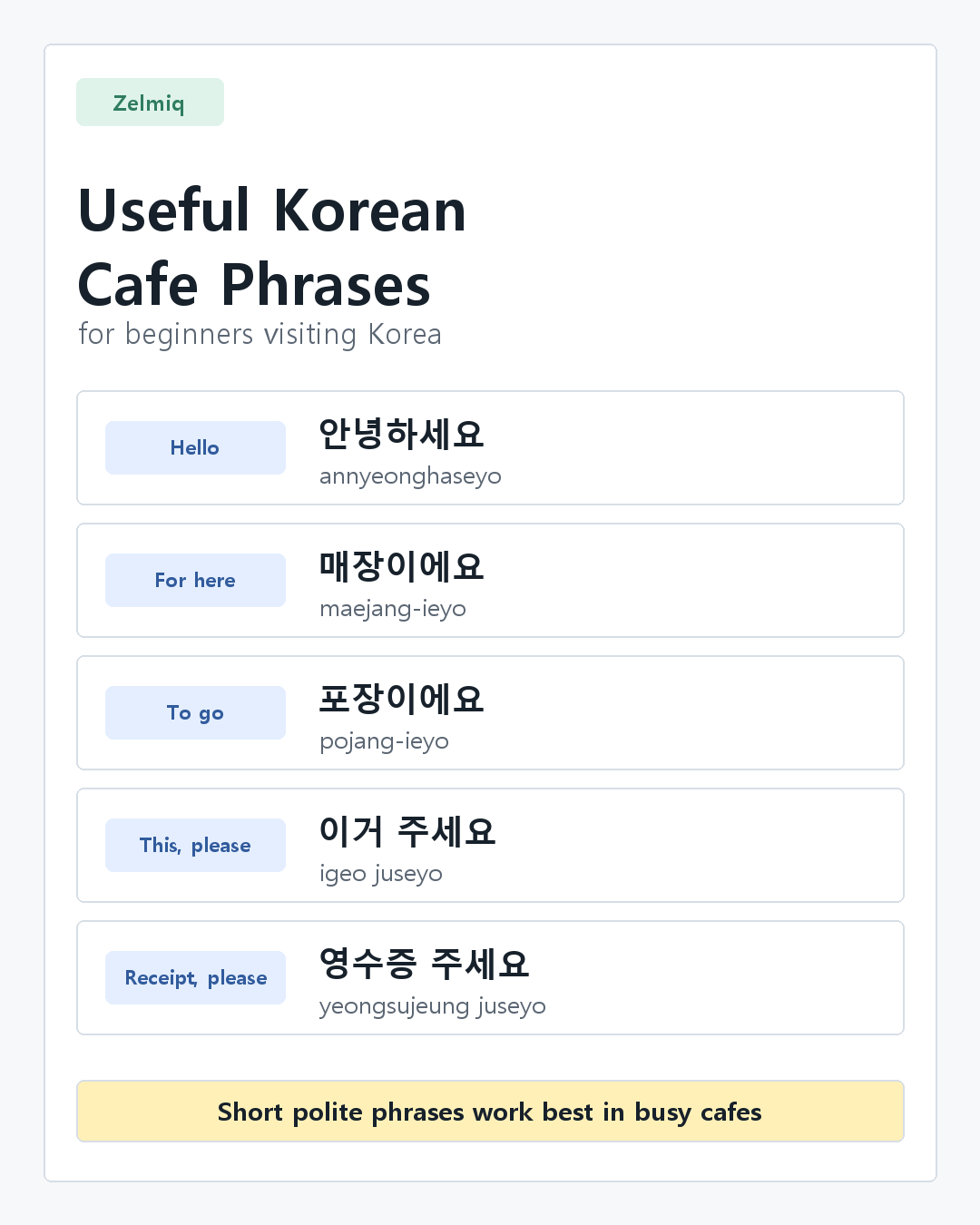
Quick Phrase List
| Korean | Romanization | Meaning |
|---|---|---|
| 안녕하세요 | annyeonghaseyo | Hello |
| 아이스 아메리카노 하나 주세요 | aiseu amerikano hana juseyo | One iced Americano, please |
| 매장이에요 | maejang-ieyo | For here |
| 포장이에요 | pojang-ieyo | To go |
| 이거 주세요 | igeo juseyo | This one, please |
| 영수증 주세요 | yeongsujeung juseyo | Receipt, please |
| 물 주세요 | mul juseyo | Water, please |
| 감사합니다 | gamsahamnida | Thank you |
1. Greeting At The Counter
안녕하세요
Romanization:
annyeonghaseyo
Meaning:
Hello.
Use this when you arrive at the counter. You do not need a long greeting. A simple annyeonghaseyo is enough.
2. Ordering A Drink
아이스 아메리카노 하나 주세요
Romanization:
aiseu amerikano hana juseyo
Meaning:
One iced Americano, please.
Pattern:
drink name + hana juseyo
Examples:
- 카페라떼 하나 주세요
- 따뜻한 아메리카노 하나 주세요
- 아이스티 하나 주세요
hana means one. juseyo means please give me.
3. Saying For Here Or To Go
매장이에요
Romanization:
maejang-ieyo
Meaning:
For here.
포장이에요
Romanization:
pojang-ieyo
Meaning:
To go.
In Korea, cafe staff may ask:
매장에서 드세요?
This means, “Are you having it here?”
You can answer:
네, 매장이에요.Yes, for here.포장이에요.To go.
4. Pointing At The Menu
이거 주세요
Romanization:
igeo juseyo
Meaning:
This one, please.
If reading the menu feels hard, pointing politely and saying igeo juseyo works well.
You can also say:
이 음료 하나 주세요.
Meaning:
One of this drink, please.
5. Asking For A Receipt
영수증 주세요
Romanization:
yeongsujeung juseyo
Meaning:
Receipt, please.
Many cafes ask whether you need a receipt. If you need one, say this after paying.
6. Asking For Water
물 주세요
Romanization:
mul juseyo
Meaning:
Water, please.
Some cafes have a self-service water station. If you do not see one, you can ask at the counter.
7. Picking Up Your Drink
Many Korean cafes use a pickup counter.
After you pay, you may receive:
- a number on your receipt,
- a vibrating buzzer,
- or your name/number called by the staff.
Useful phrase:
제 음료 나왔나요?
Romanization:
je eumryo nawannayo?
Meaning:
Is my drink ready?
Use this only if you have waited for a while and are not sure whether your drink was called.
8. Asking About Seating
여기 앉아도 돼요?
Romanization:
yeogi anjado dwaeyo?
Meaning:
Can I sit here?
This can be useful when a seat is unclear, reserved, or close to another customer.
9. Returning Your Tray
In many Korean cafes, customers return cups and trays to a return area.
Look for signs such as:
- 반납
- 퇴식구
- 컵 반납
Useful phrase:
어디에 반납하면 돼요?
Romanization:
eodie bannaphamyeon dwaeyo?
Meaning:
Where should I return this?
Mini Dialogue
Customer:
안녕하세요. 아이스 아메리카노 하나 주세요.
Staff:
매장에서 드세요?
Customer:
네, 매장이에요.
Staff:
결제 도와드릴게요.
Customer:
영수증 주세요. 감사합니다.
Common Mistakes
Do not worry too much about perfect grammar.
In a busy cafe, short and polite phrases are better than long sentences.
The most useful pattern is:
menu item + 하나 주세요
And the most useful answers are:
매장이에요 and 포장이에요.
Practical cafe flow for first-time visitors
If this is your first time ordering in a Korean cafe, think in four small steps. First, greet the staff and say the drink name clearly. Second, add the size, ice or hot option, and quantity if you know it. Third, answer whether you will stay or take it out: ????? for here or ????? to go. Fourth, listen for your order number, name, or buzzer before going to the pickup counter.
You do not need long Korean sentences to sound polite. A short phrase with ??? is usually enough. If you forget a word, point at the menu and say ?? ???. If you are unsure about seating, tray return, or pickup, use one short question and show the receipt or buzzer. This keeps the conversation simple and reduces pressure for both you and the staff.
Related Reading
- Korean Cafe Etiquette for Foreigners – learn the ordering, seating, pickup, and tray return flow.
- Korean Delivery Food Culture – useful if you want to compare cafe pickup with food delivery habits.
- Korean Banchan Culture – helpful for understanding restaurant side dishes after cafe phrases.
Survival Korean Checklist
I am preparing a short Survival Korean checklist for first-time visitors to Korea.
It will include cafe, restaurant, transportation, convenience store, and emergency phrases in one simple guide.
Disclaimer
Romanization is only a pronunciation aid. If you plan to stay in Korea longer, learning Hangul will help you read menus, signs, and place names more accurately.
Free Survival Korean Checklist
Want a quick phrase checklist for your first week in Korea? Download the free Survival Korean Starter Checklist and practice cafe, restaurant, transport, shopping, and help phrases before your trip.